In high-temperature industrial environments, heat is the enemy of image quality. As sensor temperatures rise, dark current increases, noise creeps in, and image integrity suffers. Heatsinks offer advanced cooling technologies that allow industry professionals to maintain image integrity in high temperature environments. High-performance industrial cameras often require heatsink technology to optimize imaging in extreme conditions. Here, the Basler ace 2, the JAI Spark SP-45000M-CXP4A, and the KAYA Iron CXP 0505 are compared for their operating temperature and overall footprint. Each represents a different approach to balancing high resolution, data throughput, and thermal management.
Industrial Camera Thermal & Physical Comparison
| Camera Brand & Model | Operating Temp (Housing) | Integrated Heatsink | Camera Size (L x W x H) | External Heatsink Size | Dynamic Range (Typical) |
|---|---|---|---|---|---|
| Basler ace 2 (a2A1920-51gcBAS) | -10 °C to 60 °C | No | 29 mm x 29 mm x 29.1 mm | 88 mm x 52.2 mm x 35 mm | 71.3 dB |
| JAI Spark (SP-45000M-CXP4A) | -5 °C to 45 °C | No | 62 mm x 62 mm x 40.5 mm | 62 mm x 50 mm x 30 mm | 66.0 dB |
| KAYA Iron (CXP-0505) | -40 °C to 70 °C | Yes | 44 mm x 44 mm x 38.6 mm | N/A | 70.0 dB |
Comparing Industrial Camera Heatsink Format
KAYA Iron CXP-0505
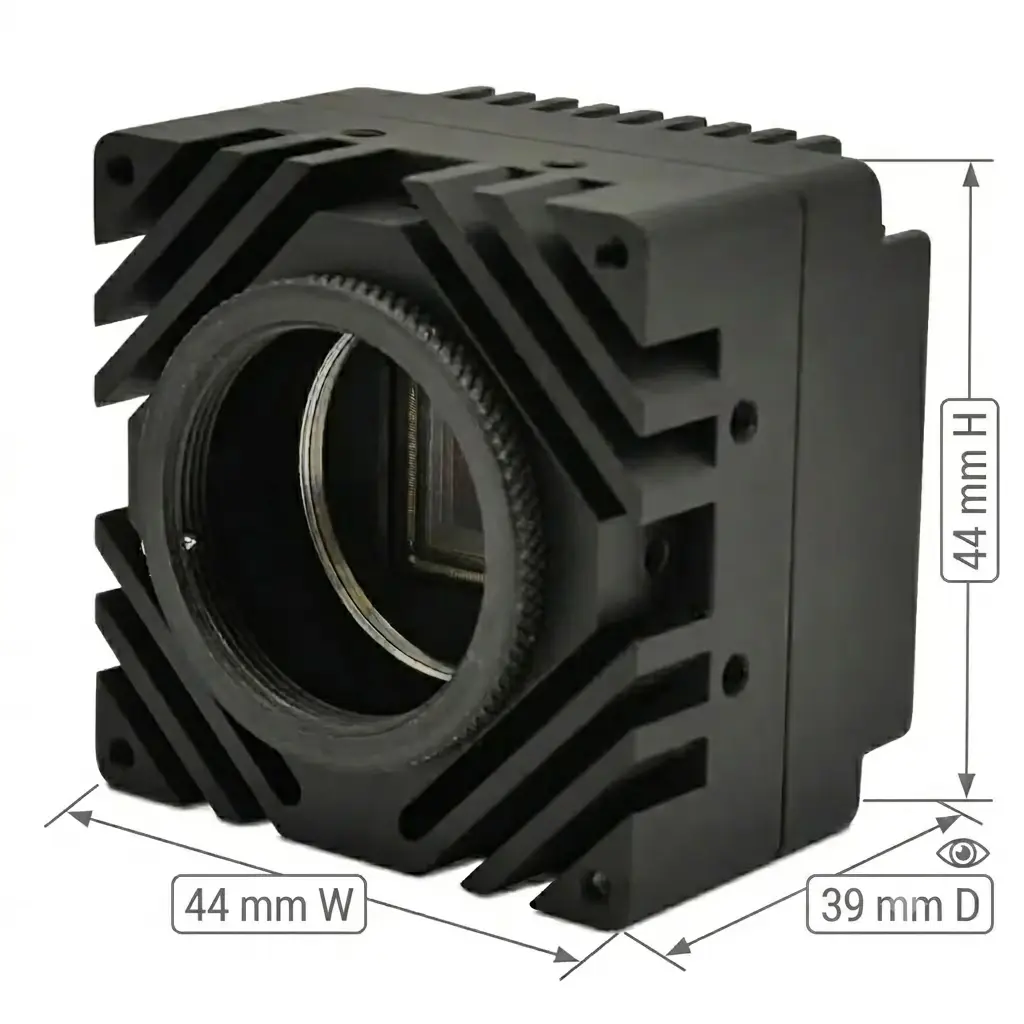
The KAYA Iron 0505 is specifically engineered for versatility in extreme conditions. Unlike the others, it features a fully integrated heatsink within its 44 mm frame, eliminating the need for bulky external cooling attachments. Its standout feature is its thermal resilience, rated for a wide range of -40 °C to 70 °C. While its SNR and dynamic range (70 dB) are highly competitive, its true value lies in its ruggedized, small form factor housing, optimal for high temperature use.
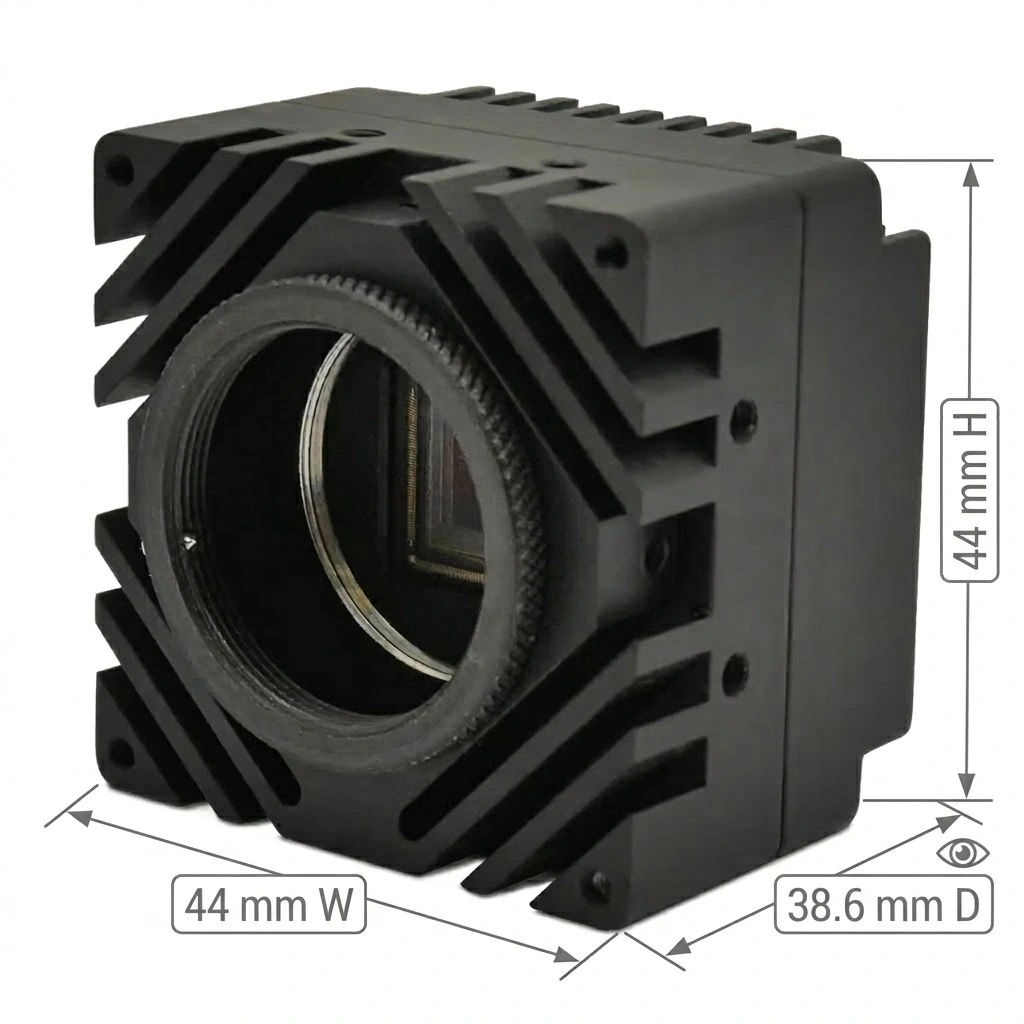
*KAYA Iron 0505 with housing measurements
Basler ace 2 (a2A1920-51gcBAS)
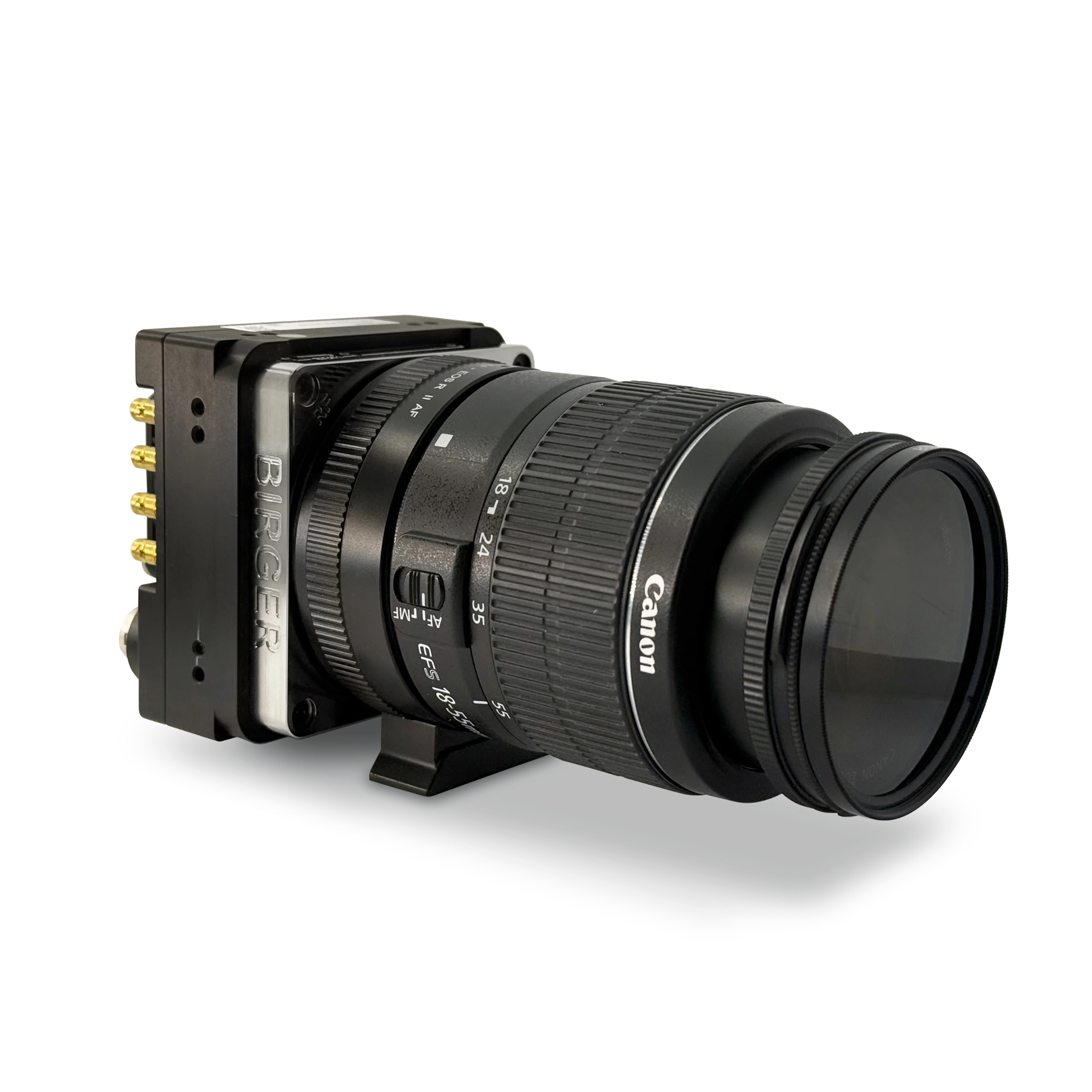
The Basler ace 2 Basic (a2A1920-51gcBAS) is a high-efficiency GigE camera. While the camera body itself is a small 29 mm cube, it requires careful thermal monitoring. While it has a high imaging performance with a 71.3 dB dynamic range. Without an integrated heatsink, using the external 88 mm x 52.2 mm x 35 mm heatsink solution solution significantly increases its footprint, making it over three times larger than the camera itself.
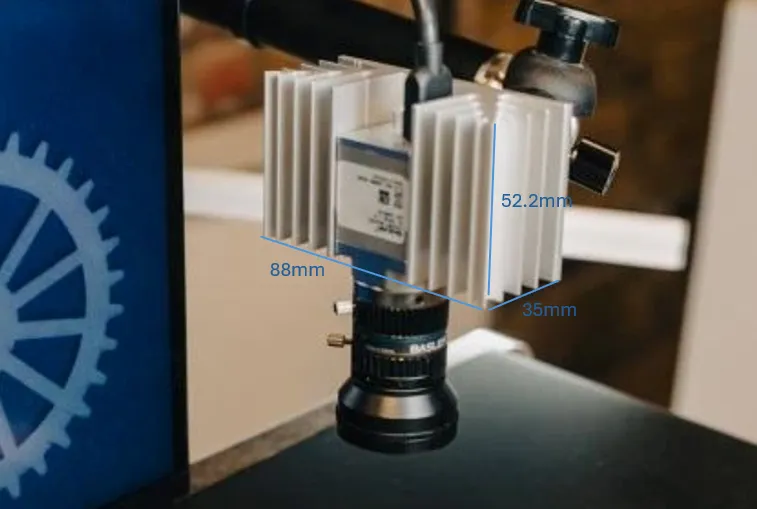
photo: drivesncontrols.com
JAI Spark Series (SP-45000M-CXP4A)
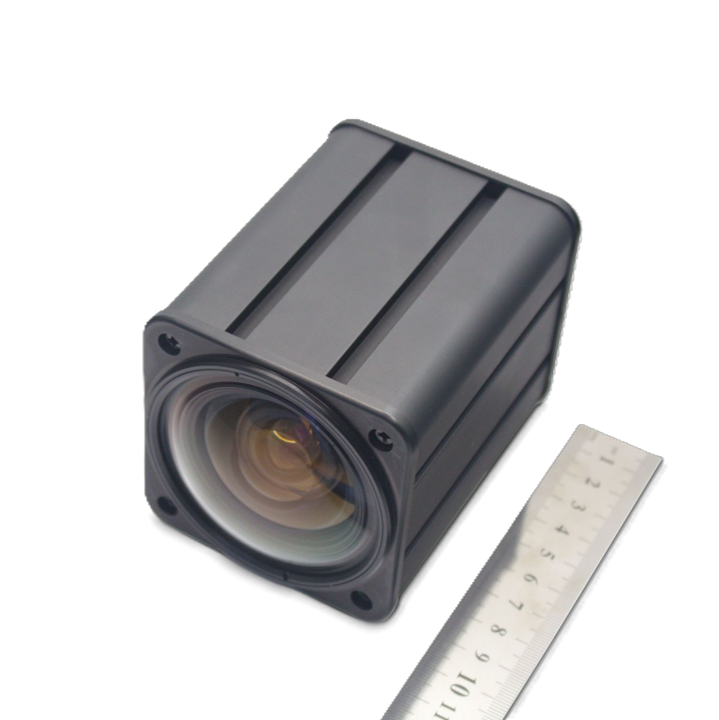
The JAI Spark SP-45000 is designed for high throughput, boasting a 44.7-megapixel resolution. the camera body is larger than both, at 62 mm x 62 mm. It operates in a narrower thermal window (-5 °C to 45 °C) and relies on an external heatsink to maintain stability during high-frame-rate operation. Despite the lower dynamic range of 66 dB compared to the others, its primary advantage is the sheer volume of data and resolution it provides for wide-area inspection.
The Critical Role of Heat Management.
In industrial imaging, heat is a risk factor that reduces clean imaging. As the sensor temperature rises, dark current increases, which manifests as thermal noise in the image. For every 6 °C to 8 °C increase in sensor temperature, the dark current roughly doubles. This reduces the effective Signal-to-Noise Ratio (SNR) and muddies the image. Constant thermal cycling (heating and cooling) can cause microscopic shifts in the sensor alignment, potentially affecting focus in high-precision metrology.
An integrated heatsink, like that on the KAYA Iron 0505, allows for a seamless installation in tight enclosures. In contrast, external heatsink models require designers to account for airflow and the extra spatial volume of external cooling fins.
If your application involves extreme temperatures or tight, unventilated spaces, the KAYA Iron 0505 is the most robust choice due to its integrated cooling and wide thermal rating. The KAYA Iron series cameras offer wide temperature range, rugged housing, and small form factor ideal in extreme conditions.