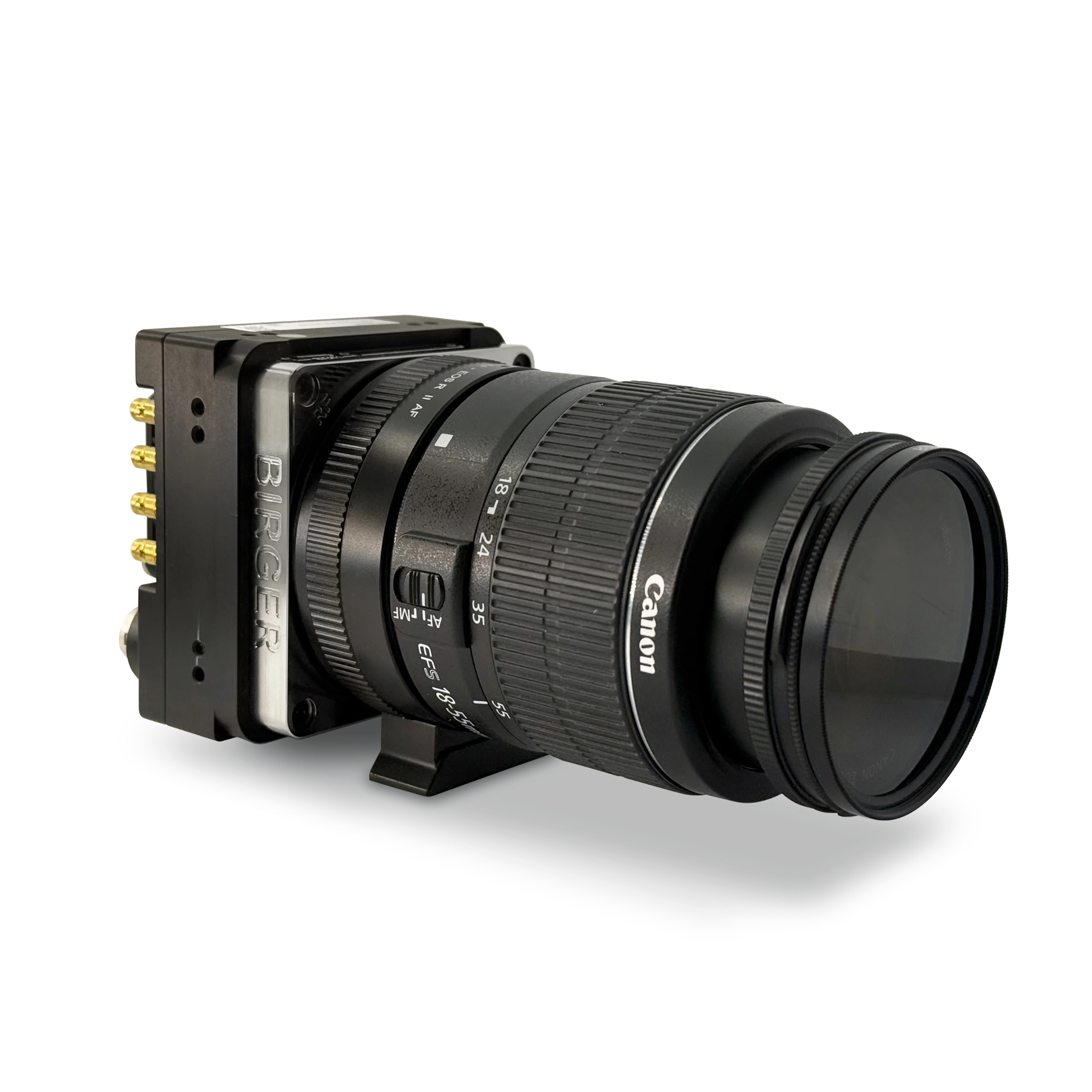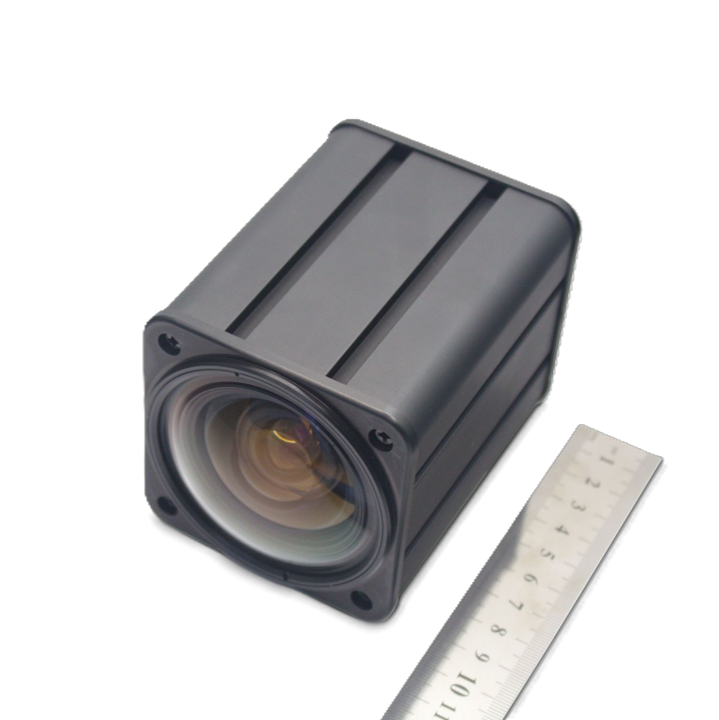
KAYA Vision has added an active RF lens mount to its Iron 4502, Iron 4510, and Iron 4521 CoaXPress cameras, giving system integrators one of the leading industrial cameras with RF mount support on the market. The new Active RF option joins the existing F, M42, EF, and Active EF mounts already offered across the Iron 45XX global shutter line, so customers can choose the glass that best fits their application without changing camera platforms.
For machine vision, aerospace, and broadcast integrators who have watched Canon’s lens roadmap shift toward the RF mount, this update means the compact size, speed, and low-power design of the Iron 45XX series can now be paired directly with Canon’s newest RF-series optics – with full electronic control of focus, iris, and, on supported lenses, zoom.
RF Mount for Industrial Cameras
Canon’s RF mount uses a 20mm flange distance, compared to 43mm for EF, providing major advantages:
- Smaller, lighter wide-angle optics. Below roughly 40mm focal length, the shorter flange distance lets lens makers skip the extra relay-lens group that EF wide-angle designs require, which typically improves sharpness, speed, and cost. Above ~40mm, RF and EF lenses are comparable in size and weight, so the benefit is concentrated exactly where compact camera housings need it most.
- Investment protection. An RF-mount camera doesn’t retire an existing EF lens inventory. A Canon-made adapter bridges EF glass – including rental-house stock – onto the RF mount, and a focal-reducer version of that adapter can pull in more light and a wider field of view from the same EF lens.
- More accurate, repeatable focus. Only a limited number of EF lenses use absolute focus encoders; nearly all current RF lenses do, which improves focus accuracy and repeatability in automated and unattended systems.
- Remote zoom control. Select RF lenses with built-in or add-on zoom motors – plus EF-mount Cine-Servo lenses – can be driven remotely through the same active-mount electronics, useful for perimeter and surveillance setups where the camera isn’t always within arm’s reach.
- A stronger mechanical connection. RF active-mount hardware uses a single-piece bayonet and housing rather than a multi-part assembly, increasing bayonet retention force, a meaningful advantage for cameras that already carry a MIL-SPEC 810F rating for shock and vibration.
- Simpler integration. Lens position can be commanded in real-world units – aperture in f-number, focus in millimeters – instead of raw motor-step values, and the control protocol is backward compatible with existing EF-based code, so integrators with a current Birger EF deployment can carry their software forward.
Birger Engineering
KAYA’s active-mount lens control incorporates birgerCTRL technology from Birger Engineering, a Boston-based lens-control specialist and KAYA’s partner for motorized Canon lens control. Founded in 1999, Birger Engineering has built remote and automated lens-control systems for the machine vision, broadcast, and entertainment industries, and its birgerCTRL technology plays a role in the Active EF and Active RF mounts across the Iron 45XX line.
Meet the Iron 45XX Series
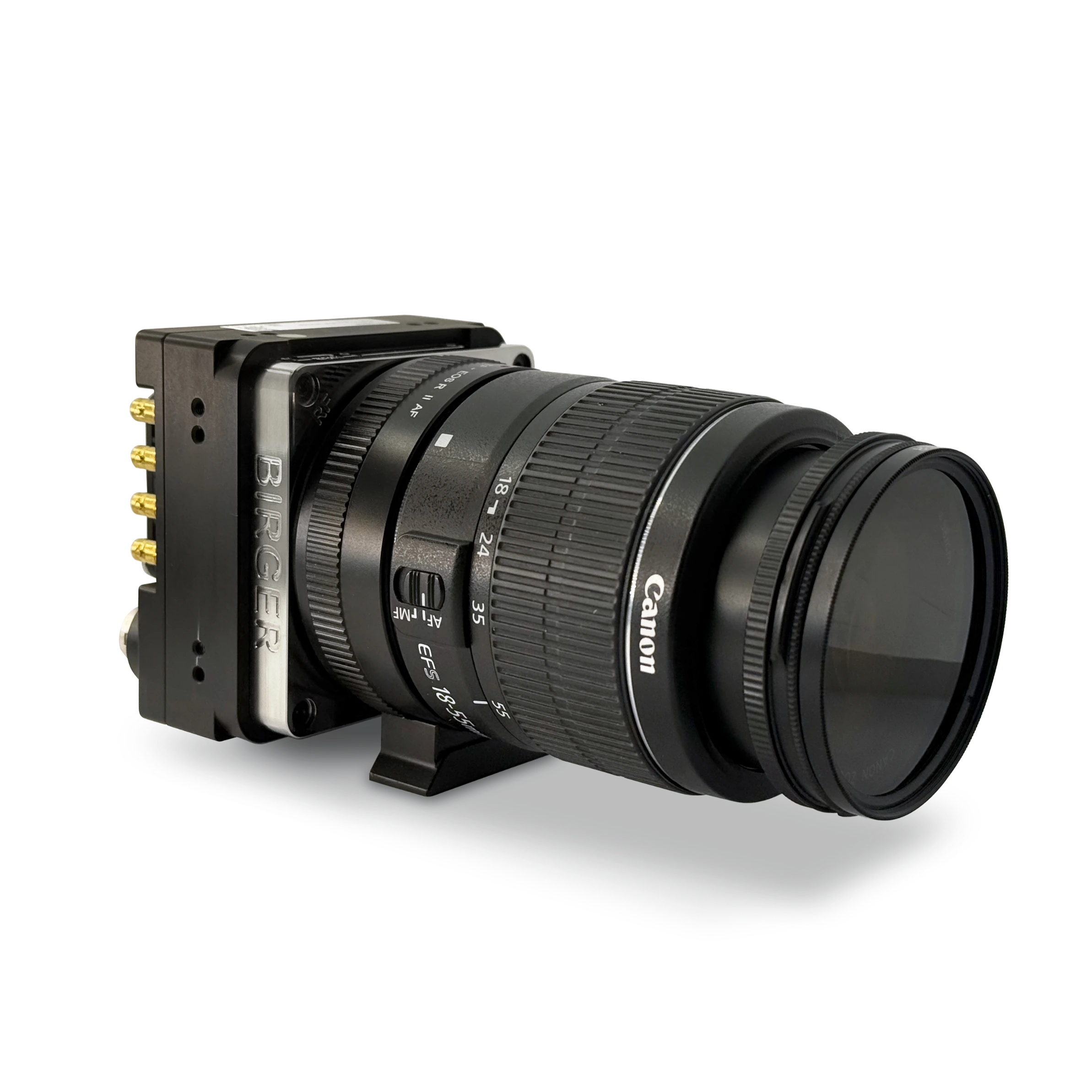
All three cameras share the same 4.5µm-pixel global shutter architecture, CoaXPress interface, and rugged mechanical platform, they differ mainly in resolution and top frame rate, letting integrators pick the right balance of detail and speed for the application.
Iron 4502 – 2.1 MP up to 1,430 fps
The Iron 4502 is the speed-focused member of the family, built around the GSPRINT 4502 global shutter sensor for high-frame-rate capture in a small footprint. It’s suited to fast-moving inspection lines, motion analysis, and applications where frame rate matters more than pixel count.
Iron 4510 – 10 MP up to 487 fps
The Iron 4510 balances resolution and speed on the GSPRINT 4510 sensor, aimed at applications that need finer detail – wide-area surveillance, mapping, and inspection- without giving up high-speed capture.
Iron 4521 – 21 MP up to 232 fps
The Iron 4521 leads the series on resolution, pairing an APS-C-format GSPRINT 4521 sensor with global shutter capture for detail-critical work such as 3D imaging, large-scene perimeter monitoring, and high-resolution special-effects capture.
Applications
- Perimeter and wide-area security vision
- Aerospace and defense imaging
- 3D imaging and metrology
- Low-light surveillance
- Broadcast and special-effects capture
- Virtual reality (VR) content capture
Frequently Asked Questions
What is an RF mount?
RF is Canon’s mirrorless lens mount, introduced alongside the EOS R system. It uses a much shorter flange distance – 20mm, versus 43mm for Canon’s older EF mount – which lets lens designers build shorter, lighter optics and gives camera engineers a shorter, more direct path between lens and sensor.
What’s the difference between EF and RF lenses?
The core difference is flange distance. EF is Canon’s DSLR-era mount at 43mm; RF is the newer mirrorless mount at 20mm. Below about 40mm focal length, that shorter distance lets RF wide-angle lenses skip an extra internal relay-lens group that EF designs need, making them smaller, lighter, and often sharper. Above ~40mm, EF and RF lenses are roughly the same size and weight, and EF glass can still be used on RF mounts via an adapter.
Can Canon RF lenses be used on industrial or machine vision cameras?
Increasingly, yes. Most industrial and CoaXPress cameras historically supported only C-mount, F-mount, or EF (via an active adapter), since RF is a newer format. Camera makers are now starting to add native active RF mount, for example, KAYA Vision’s Iron 4502, 4510, and 4521 CoaXPress cameras – that give direct electronic control of an RF lens’s focus, iris, and, on supported lenses, zoom.
For pricing, lead times, or to discuss an RF-mount integration, contact KAYA Vision directly.