Ultra Low Light
STARVIS 2 BSI architecture with <2.8 e⁻ noise floor and >80% quantum efficiency - the IMX662 holds usable colour video further into darkness than any STARVIS 1 sensor at the same pixel pitch.
Iron SDI 662 · Sony IMX662
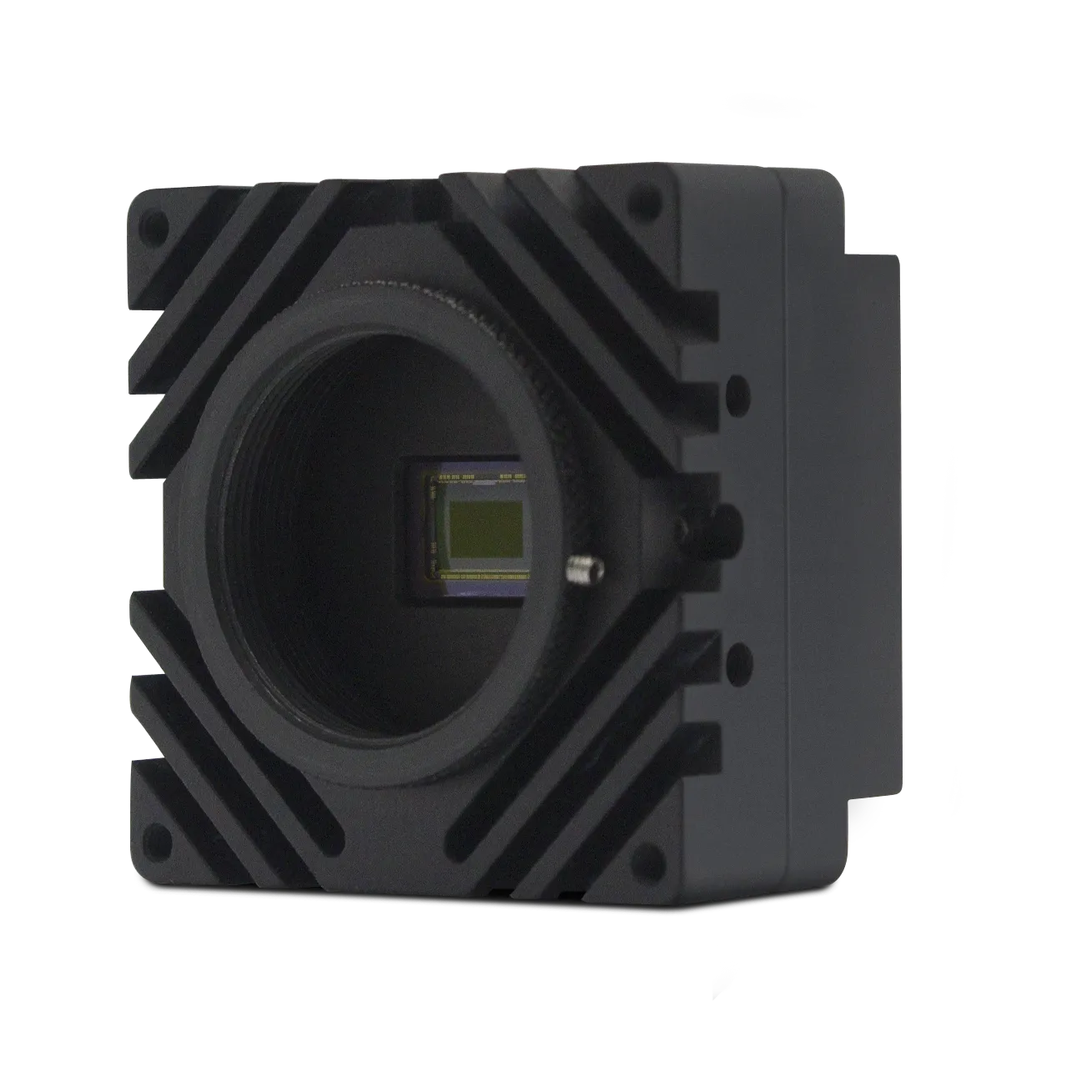
The Iron SDI 662 replaces the Iron SDI 462 with Sony's second-generation back-illuminated sensor — delivering wider single-exposure dynamic range, cleaner low-light imagery, and artifact-free Clear HDR in the same compact 44 × 44 mm form factor.
Sony STARVIS 2 - What Changed
The IMX662 is Sony's second-generation STARVIS back-illuminated sensor. Where STARVIS 1 improved sensitivity by moving the photodiode in front of the wiring layer, STARVIS 2 goes further - redesigning the photodiode separation walls to increase photon storage capacity, reduce crosstalk between pixels, and deliver a wider dynamic range in a single exposure without resorting to multi-frame HDR.
Head-to-head: IMX462 (STARVIS 1) vs IMX662 (STARVIS 2)
| Metric | Iron SDI 462 EOL | Iron SDI 662 New |
|---|---|---|
| Sensor | IMX462 - STARVIS 1 | IMX662 - STARVIS 2 |
| Pixel / Format | 2.9 µm / 1/2.8" | 2.9 µm / 1/2.8" |
| Dynamic range | ~64 dB | >74 dB (+8 dB in single exposure) |
| Quantum efficiency | ~70% @ 520 nm | >80% @ 520 nm |
| HDR method | DOL-HDR (multi-frame) | Clear HDR (single exposure) |
| Motion artifacts in HDR | Ghosting possible | Eliminated |
| NIR sensitivity | Good | Improved (redesigned walls) |
| Power | Higher | Lower |
Sony specifies a wider dynamic range for STARVIS 2 vs STARVIS 1 at equal pixel size in a single exposure (IMX662 product flyer, Sony Semiconductor Solutions). The Iron SDI 462 has reached end-of-life; the Iron SDI 662 is the direct replacement.
Three structural improvements
STARVIS 2 delivers >70 dB in a single frame - more than 8 dB wider than its predecessor at the same pixel pitch - so there is no need to merge two or more frames in post. Bright highlights and deep shadows coexist in every image.
Digital Overlap HDR (used by the IMX462) merges sequentially captured frames, introducing ghosting on fast-moving subjects. STARVIS 2's Clear HDR fuses high- and low-gain signals simultaneously, eliminating chromatic fringing and blur at any shutter speed.
The hallmark structural change of STARVIS 2: new separation walls increase the capacity of each photodiode to store photons before saturation, reducing inter-pixel crosstalk, improving NIR response (useful for IR-illuminated scenes), and lowering overall power draw.
Iron SDI 662 - Camera Features
The Iron SDI 662 puts the IMX662 inside KAYA's proven Iron ruggedised enclosure - adding MIL-STD-810G qualification, a −40 °C to 80 °C operating range, and a full image-processing feature set over a standard 3G-SDI link.
STARVIS 2 BSI architecture with <2.8 e⁻ noise floor and >80% quantum efficiency - the IMX662 holds usable colour video further into darkness than any STARVIS 1 sensor at the same pixel pitch.
Single-link HD-SDI and 3G-SDI support. 1080p up to 60 fps at 10-bit 4:2:2 Y'Cb'Cr'. Standard HD-BNC connector; optional MCX. Drop-in compatible with existing SDI infrastructure.
Tested to MIL-STD-810G Method 516.6 (75G shock) and Method 514.6 (vibration category 20). Optional IP67 sealing available with the KAYA protective lens tube for wet or dusty environments.
Defect pixel correction, auto/manual exposure and gain, white balance, LUT, defog, RGB offsets, saturation control, and colour correction matrix - all configurable over RS-232 or Bluetooth via the SDI Control Point app.
44 × 44 × 34.82 mm and ~50 g. Fits the same mounting envelope as the Iron SDI 462, so existing designs and IP67 enclosure builds can be upgraded without mechanical changes.

Fully operational from - 40 °C to +80 °C with 20–85% humidity (non-condensing). Storage to −40 °C / +85 °C. 2,100,000-hour MTBF (Telcordia, 50 °C).

Typical 2.4 W at 12 V DC (maximum 3.4 W at 28 V, 80 °C). Wide 5–28 V input. STARVIS 2's structural improvements also reduce power draw compared to the first-generation sensor at equivalent frame rate.

The same IMX662 STARVIS 2 sensor is available as the Iron 662 CoaXPress (CXP v2.1, up to 90 fps at 10-bit). Both cameras share the identical form factor and qualification level.
Direct Replacement
The Iron SDI 462 is now at end-of-life. The Iron SDI 662 is its pin-compatible successor: same 44 × 44 mm footprint, same lens mounts, same SDI output. The only difference is a meaningfully better sensor inside.
Iron SDI 662 · Camera
The Iron SDI 662 delivers Sony's latest low-light technology in KAYA's proven ruggedised package. It is a direct mechanical and interface-compatible replacement for the Iron SDI 462, and it is available now for evaluation and production.
Specifications
Essential figures at a glance. Full datasheets - including all video modes, I/O, and mechanical drawings - are available on the product pages.
Full datasheets & downloads
Complete specs, video mode tables, mechanical drawings, and the SDI Control Point app are on the product pages.
Common Questions
Yes. Both cameras use the same 44 × 44 mm form factor, the same C/CS/M12 lens mounts, and the same HD-BNC 3G-SDI output. The Iron SDI 462 is end-of-life; KAYA recommends the Iron SDI 662 as its direct successor. No mechanical or interface changes are required for existing designs.
The three most noticeable differences in day-to-day operation are: (1) wider dynamic range in a single frame - over 70 dB versus roughly 64 dB - so scenes with a bright window and a shadowed corner are handled in one exposure; (2) Clear HDR, which fuses high- and low-gain signals simultaneously and eliminates the ghosting or chromatic fringing that DOL-HDR can produce on fast-moving subjects; and (3) improved low-light performance, driven by higher quantum efficiency (>80% vs ~70%) and redesigned photodiode separation walls that store more photons before saturation.
Yes. Analog video output is available as an option on the Iron SDI 662, matching the same optional output that the Iron SDI 462 offered. Contact KAYA Vision to configure this at time of order.
IP67 ingress protection is available as an option via KAYA's protective lens tube. For more demanding deployments, KAYA also builds fully custom IP67 enclosures around the Iron camera series - configurable with heaters, nitrogen purge, and DO-160G qualification. Contact KAYA for a custom enclosure quote.
Yes. The Iron SDI 662 is built for demanding industrial, airborne, and outdoor deployments. The camera operates from −40 °C to +80 °C, is qualified to MIL-STD-810G shock and vibration standards, and is available with optional IP67 sealing using KAYA's protective lens tube. Its compact aluminium enclosure and low 2.4 W power draw also make it well suited for space-constrained or thermally challenging systems.
Iron SDI 662 - Available Now
The Iron SDI 662 is in production and available for evaluation. Get the datasheet, configure an IP67 enclosure, or speak with a KAYA engineer about your application.