What is SpaceFibre
SpaceFibre (also referred to as space fiber in the US) communications involve using fiber-optic networks aboard spacecraft and satellites to transmit large volumes of data at multi-gigabit speeds. Traditional spacecraft communication buses, such as SpaceWire and MIL-STD-1553, are not efficient enough for the high-performance requirements of modern sensors and satellite systems. The latest sensors have high-data rates and high-dynamic range which add tremendous capabilities to imaging platforms. SpaceWire and MIL-STD-1553 have limited bandwidth and require bulky copper harnesses. In contrast, fiber-optic links provide extremely high data throughput and greatly reduced cable weight. For example, the European Space Agency (ESA) notes that the SpaceFibre standard (a space-grade optical network protocol) delivers up to 6.25 Gbps per lane – about 15× the rate of SpaceWire – while cutting harness mass by roughly 50% (and over 90% per bit) compared to copper links. NASA has likewise recognized SpaceFibre as a high speed optical extension to the SpaceWire protocol, with NASA and DoD actively exploring its use for future missions.
Overall, fiber-optic systems are increasingly widespread in spaceflight: Fiber-optic subsystems are now offering increasingly wide utilizations in space systems, where the reliability and environmental resilience of fiber components is mission-critical.
Fiber-optic space networks bring several major advantages over electrical cables: they can carry far more data while adding almost no weight, and they are immune to electromagnetic interference and grounding issues. Because optical fibers do not conduct electricity, they eliminate ground-loop faults between spacecraft subsystems. Fibers also greatly simplify integration and testing: subsystem transmitters and receivers can be pre-qualified on the ground, then simply “plugged” together in orbit with clean fiber connectors. The result is fewer custom harnesses and COTS (commercial off-the-shelf) components that reduce cost and risk. Crucially, fiber-optic links support exceptionally high data rates and scalability: the same fiber network designed for 1 Mbps can often scale to 20 Mbps or beyond without rewiring. These traits make fiber-optics ideally suited for modern satellites that handle streaming high-resolution imagery, sensor data, and video.
Optical fiber cables (as shown above) lie at the heart of SpaceFibre networks, enabling multi-gigabit data transfer with negligible electromagnetic interference.
Key advantages of fiber-optic links in spacecraft networks include:
- Dramatically reduced weight: Optical fiber cables are far lighter than equivalent copper harnesses (e.g. replacing a 10 kg copper cable bundle with a 0.1 kg fiber ring).
- Immunity to EMI/ground loops: Fiber links do not emit or pick up electromagnetic noise, avoiding cross-talk and ground-loop failures that plague electrical buses.
- Simplified integration and testing: Fiber subsystems can be calibrated and tested independently on the ground. During assembly, fiber connectors merely need cleaning and mating, reducing the risk of damage to delicate avionics.
- Use of COTS components: Many optical fibers, connectors, and transceivers are commercially available. This reduces custom development and allows easy replacement of damaged cables.
- Scalability to higher speeds: The same fiber bus architecture can often be upgraded to much higher data rates without adding new cables or conductors.
ESA’s SpaceFibre standard, ECSS-E-ST-50-11C embodies the concept of “space fiber” networking. SpaceFibre was designed as the successor to the popular SpaceWire protocol, extending it with multi-gigabit throughput and advanced reliability features. Each SpaceFibre link can deliver 3–6 Gbps per lane in current radiation-tolerant hardware, and even higher rates (up to ~25 Gbps) when using multiple lanes or next-generation ASICs. By using multiple parallel lanes, a single SpaceFibre link can reach tens of gigabits per second. Critically, SpaceFibre inherits SpaceWire’s packet format at the network layer, so existing SpaceWire equipment can communicate over a SpaceFibre network (via a simple bridge). In short, SpaceFibre provides an open, non-proprietary framework for on-board networks that natively run over fiber-optic or copper physical links.
SpaceFibre includes many space-grade features in hardware: it implements virtual channels for prioritized, deterministic Quality-of-Service (QoS), and it has built-in fault detection, isolation, and recovery (FDIR) so that link errors are automatically detected and retried without software intervention.
SpaceFibre also offers low-latency broadcast messaging, used to distribute timing signals and events across the spacecraft. Its protocol overhead is minimal and independent of packet size, yielding low jitter and rapid delivery even under tight timing constraints. The European Cooperation for Space Standardization highlights these points:
- SpaceFibre runs at many Gigabits per Second with only minimum buffer requirements
- SpaceFibre supports deterministic communication through virtual channel isolation fully in hardware
- SpaceFibre includes ultra-fast error-recovery (on the order of microseconds)
In practice, this means SpaceFibre can handle very high data-rate streams (e.g. video, scientific instruments) while ensuring critical control or navigation traffic is delivered on time with guaranteed bandwidth. Multiple virtual links can share one physical cable, each with its own priority and reserved bandwidth. This allows critical telemetry or control data to coexist with large instrument data streams without interference.
Further advantages of SpaceFibre, are that it uses the same packet structure as SpaceWire, so legacy SpaceWire nodes can be integrated via simple bridging. This eases the transition and reuse of equipment. SpaceFibre’s design eliminates store-and-forward delays, yielding very low latency. It also supports prioritized broadcast messages (e.g. 8-byte time packets) for synchronization and event signaling. SpaceFibre is standardized by ECSS and was developed with input from ESA, NASA, JAXA and industry. The official ECSS document (E-ST-50-11C) enables any manufacturer to build compliant hardware without proprietary constraints.
SpaceFibre Implementation and Hardware Considerations
Building space fiber networks requires space-qualified components. SpaceFibre IP cores are already available for a range of radiation-hardened FPGAs. These cores take minimal FPGA resources (a few percent of an RTG4) so that a rad-tolerant device can host multiple SpaceFibre links plus application logic. On the physical side, SpaceFibre serializes data using high-speed Serializer/Deserializer (SerDes) blocks, often using current-mode logic (CML) drivers for differential links. Electrical versions can run over cables, but long runs generally use fiber-optic transceivers. These transceivers typically require precise alignment, and testing involves measuring eye diagrams and bit-error rates to ensure signal integrity.
Fiber-optic cables and connectors themselves must be space-rated. Standards like ISO 20780 and ECSS-Q-70 define design and verification requirements for fiber components in space (temperature cycling, vibration, vacuum, and radiation tolerance). The International Organization for Standardization (ISO) notes that the reliability and environmental adaptability of fiber-optic components are essential to a system’s lifetime in space and constitute a critical factor in mission success and scheduling. Achieving this requires practical steps such as using radiation-hardened glass, installing hermetically sealed connectors, and implementing qualified manufacturing processes. For instance, specialized radiation-resistant fibers and dopants are often necessary to minimize signal degradation in high-radiation orbits. Additionally, flight projects frequently mandate multi-mode or single-mode fibers with a proven heritage in space.
Overall, deploying space fiber involves detailed qualification at both the link and component level. But the payoff is a common, high-performance network that can serve payload instruments, mass-memory modules, avionics, and inter-satellite links alike. Because SpaceFibre is an open standard, agencies and manufacturers can jointly develop routers and switches to build complex infrastructure. Several research efforts (including ESA’s TRP programs) are also working on hardened SpaceFibre routers and ASICs to fully support this ecosystem.
SpaceFibre Applications and Mission Scenarios
Space fiber networks are designed to support spacecraft with high-bandwidth requirements. This includes tasking or daily Earth-observation satellites with multi-spectral imagers, synthetic aperture radar (SAR) platforms, space telescopes, and future deep-space probes carrying advanced sensor payloads. In addition, large on-board data recorders (solid-state drives) often need gigabit interconnects to stream data from several instruments simultaneously; a SpaceFibre backbone can handle this without multiple parallel networks. Human-rated spacecraft also utilize SpaceFibre for avionics control buses, benefiting from its deterministic quality of service.
Another compelling scenario is integration of multiple systems: with a single fiber-based network, a satellite can consolidate telemetry, payload data, timing distribution, and command/control. For example, a single SpaceFibre link could carry high-resolution video downlink data, while another virtual channel on the same link handles attitude control messages with guaranteed low latency. Fiber backbones are also well-suited for distributed satellite constellations or space stations where modules are connected by fiber-optic cables. Even for launch vehicles, SpaceFibre’s long-distance capability and EMI immunity mean that a single network might serve sensors, cameras, and telemetry throughout the rocket.
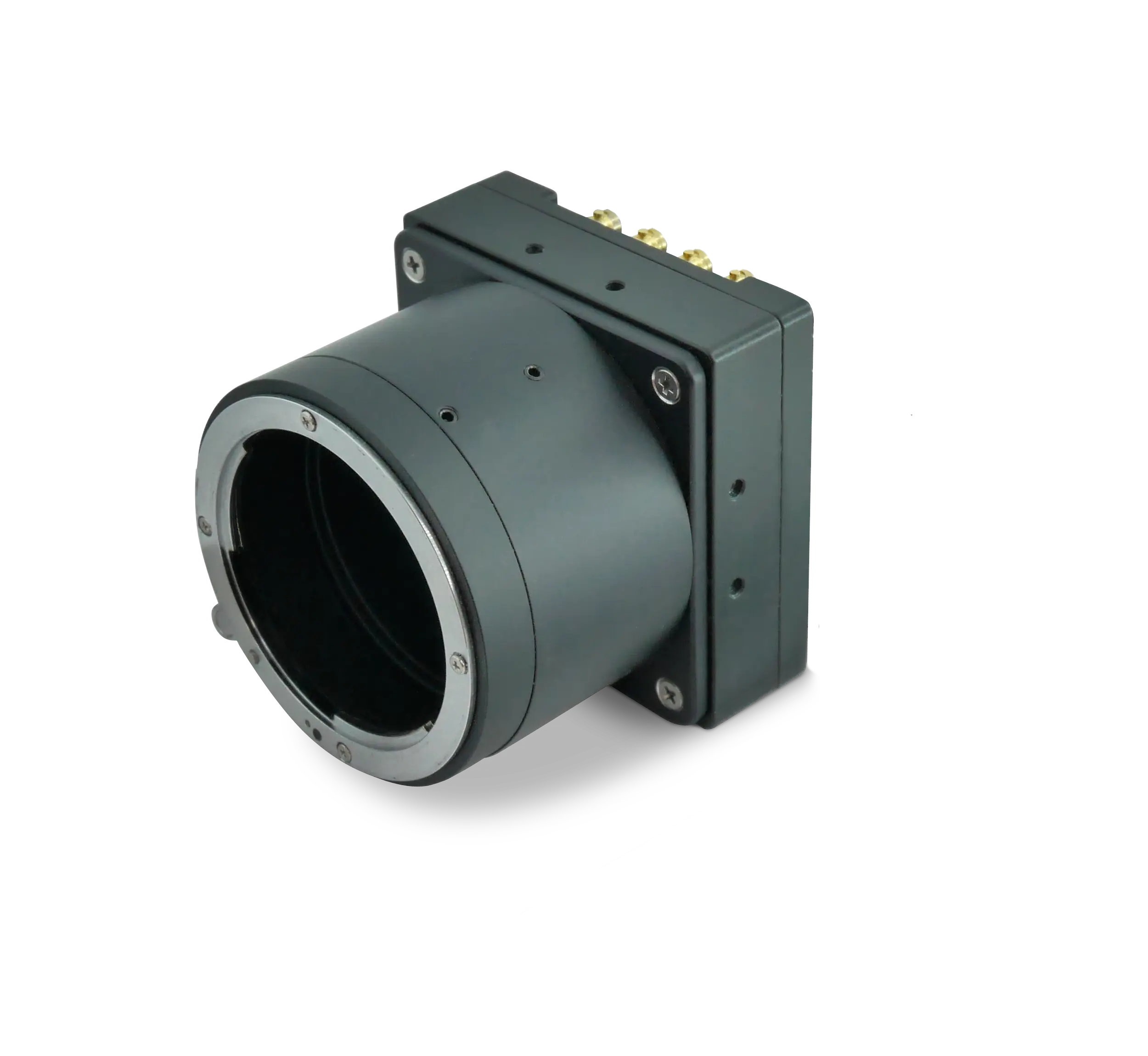
Finally, fiber optics is already being tested in spaceflight: NASA and ESA have flown fiber-optic hardware (connectors, sensors, and manufacturing experiments) on the ISS and missions like Orion. ESA’s SpaceFibre on-board interconnect project demonstrated multi-gigabit transfers over fiber in a lab. Although no operational mission has yet fully switched to SpaceFibre, the technology readiness is steadily increasing. As the standard matures, we expect near-term flight demonstrations and eventually mission adoption. KAYA Vision is tracking these developments: our cameras and interfaces are being built with fiber networks in mind, so they can plug into next-generation space communication standards when they arrive.