Is CoaXPress faster than 10GigE for megapixel cameras?
The short answer is yes. CoaXPress v2.0 delivers a raw data rate of 12.5 Gbps per lane, and most contemporary frame grabbers support four concurrent lanes, giving an aggregate 50 Gbps of deterministic bandwidth. By contrast, 10GigE tops out at a theoretical 10 Gbps that must also absorb TCP/IP overhead, error-correction headers and additional latency introduced by network switches. In independent benches, CoaXPress v2.0 sustains at least three times more useful payload than 10GigE, a gap that widens with higher bit depths and larger resolutions.
Latency is equally decisive for high-speed machine vision. CoaXPress typically achieves sub-microsecond trigger-to-image latency because clock, data and camera-control signals share the same coaxial cable. 10GigE, even with hardware time stamping, rarely dips below 100 µs, and that margin can derail precision timing in AOI, SMT inspection or motion-guided pick-and-place. For closed-loop, deterministic applications where every microsecond counts, vision engineers overwhelmingly favor CoaXPress.
Cable length further underlines the edge: up to 40 m at CXP-12 on standard RG-6 coax, compared with 100 m for 10GigE only if you tolerate added latency from switches and potential packet loss. With CoaXPress you also gain PoCXP—camera power and data on the same line—simplifying integration and improving EMI immunity in electrically noisy factory environments.
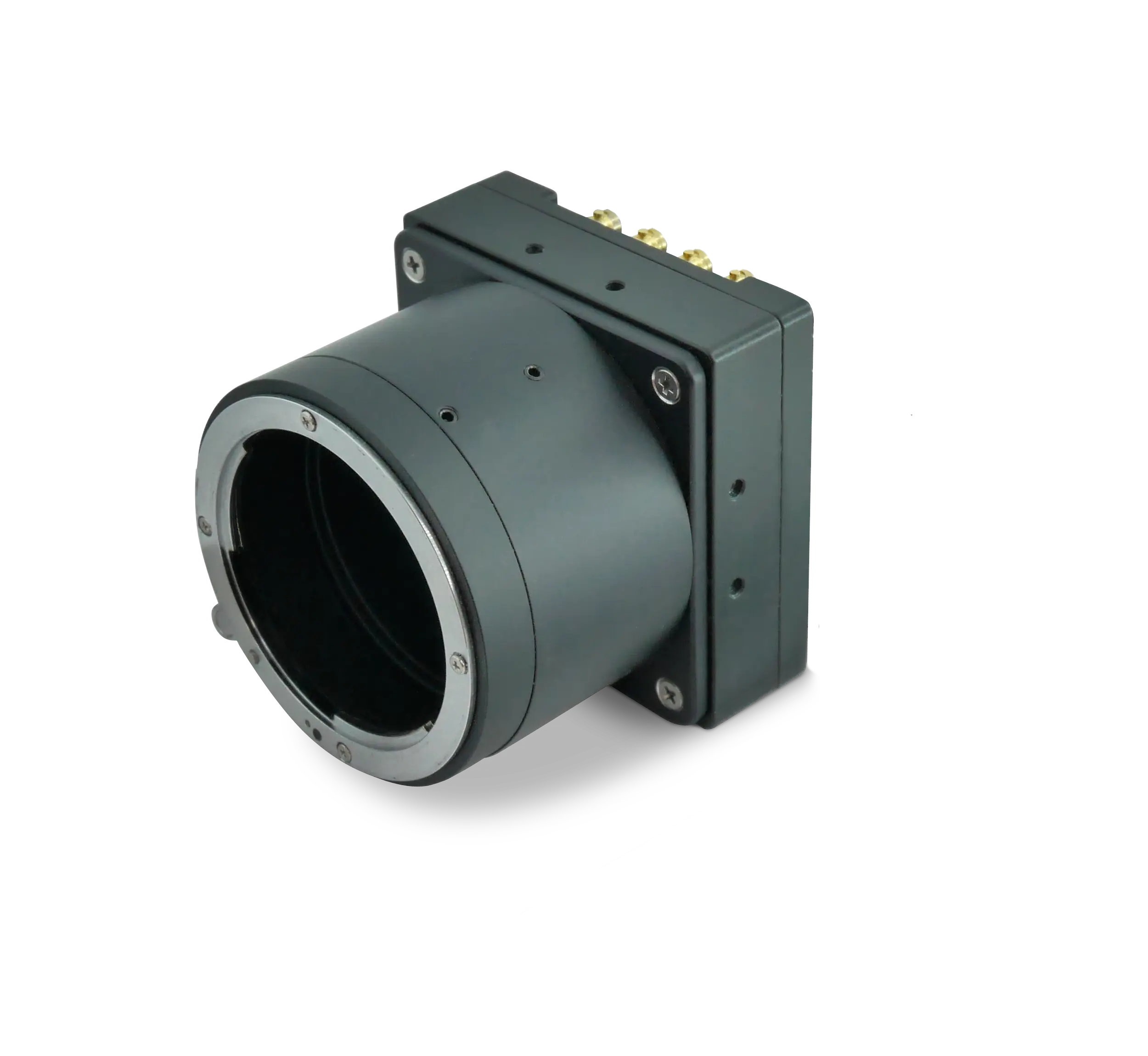
The Iron 927 megapixel camera neatly illustrates the need for that extra bandwidth. A single full-resolution frame contains 10240 × 10240 pixels—roughly 105 MB at 8-bit. At the camera’s maximum 46 fps, that is about 4.8 GB/s, or 38.6 Gbps of raw data. A 10GigE link would instantly saturate, forcing compression or severe frame-rate reductions. Four-lane CXP-12, however, streams Iron 927 data with comfortable headroom for 10- or 12-bit modes, which push the data rate higher still. This is why CoaXPress remains the preferred interface for ultra-high-resolution sensors.
Which frame grabber pairs best with Iron 927?
For the Iron 927, KAYA Vision’s Komodo II CXP-12 frame grabber is the go-to partner. The board exposes four independent 12.5 Gbps lanes that map directly to the camera’s four Micro-BNC outputs, so one coax per lane brings data, trigger and PoCXP power online in minutes.
Inside the host computer, Komodo II connects through a high-bandwidth PCIe interface that comfortably exceeds the 38 Gbps stream arriving from the Iron 927. Direct Memory Access moves images into system RAM or GPU memory with negligible CPU overhead—an advantage when deploying CUDA-based inspection or other real-time algorithms.
Hardware features add further value. Programmable I/O lines, timers and counters synchronize cleanly with the Iron 927’s global shutter, while multi-board clock sharing makes stereo or multi-camera rigs straightforward. Together, the camera and frame grabber provide deterministic timing, ample bandwidth and round-the-clock reliability proven on industrial floors.
Software integration is equally straightforward. Both devices are fully GenICam compliant, so exposure, ROI, LUTs and event notifications appear in the same standardized feature tree. Developers can prototype with the KAYA Vision SDK or popular vision libraries such as HALCON and OpenCV without rewriting control code, shortening time to deployment.
How does Iron 927 avoid data bottlenecks?
The Iron 927 megapixel camera tackles data congestion on three complementary fronts: sensor design, interface technology and on-camera preprocessing.
1. Sensor design. Its Sony IMX927 CMOS sensor combines 2.74 µm backside-illuminated pixels with low temporal noise (<2.7 e⁻) to deliver more than 70 dB dynamic range. High native sensitivity allows shorter exposures or lower analog gain, reducing the need for downstream noise-reduction steps that would otherwise inflate cycle time.
2. Interface technology. The camera natively supports CoaXPress v2.1 at CXP-12, pushing 12.5 Gbps through each of its four lanes. That enables sustained 46 fps at full 102 MP resolution and 8-bit depth without subsampling or external compression. Even at 10-bit (37 fps) or 12-bit (31 fps), the aggregate 50 Gbps link carries the stream unthrottled.
3. On-camera preprocessing. Iron 927 offers bandwidth-saving tools accessible via GenICam. Region of Interest (ROI) windows let you stream only critical portions of the sensor, cutting data volume in direct proportion to ROI size. Binning merges adjacent pixels to lift SNR while trimming resolution; partial scanning reduces vertical resolution for panoramic monitoring. In triggered-burst mode, images are transferred only when an external event—such as a part passing an encoder—fires the shutter, holding line utilization near zero between events.
Additional engineering touches reinforce continuous throughput. The camera’s power consumption stays under 14 W, which stabilizes temperature, keeps noise predictable and minimizes frame discard. A built-in frame counter and operational time counter aid host-side DMA scheduling, ensuring each image arrives exactly where and when the application expects it.
Altogether, Iron 927 exemplifies a balanced architecture in which sensor, interface and processing co-operate to keep data flowing rather than piling up in buffers. For demanding inspection, metrology or aerial-mapping projects where resolution rivals medium-format photography yet timing rivals motion analysis, the pairing of Iron 927 with a four-lane CXP-12 frame grabber removes the last data bottleneck.
Key takeaways for system designers
- Throughput: Iron 927 at full resolution and 8-bit depth pushes 38.6 Gbps—well beyond 10GigE but comfortably within a four-lane CXP-12 budget.
- Determinism: Sub-microsecond latency and GenICam control give predictable timing essential for closed-loop automation.
- Scalability: Multi-board synchronization and ROI/burst modes let engineers optimize bandwidth when adding more cameras or increasing bit depth.
- Simplicity: PoCXP delivers power, data and control over a single coax per lane, reducing cable bulk and improving EMI immunity.
- Reliability: Industrial-grade temperature range, shock and vibration ratings, plus an MTBF of 1.6 million hours, back 24/7 factory use.
By matching a sensor that pushes the limits of spatial resolution with an interface built expressly for high-speed, deterministic transfer, KAYA Vision makes it practical to integrate 100-megapixel imaging into real-time production tasks. When every pixel and every microsecond matter, CoaXPress v2.1 and the Iron 927 provide the throughput margin that modern machine-vision systems demand.