High-speed crash test cameras provide manufacturers and drivers with peace of mind by offering the best for vehicle safety standards. Until recently, the frame-by-frame analysis of automobile impacts relied on legacy film systems or early digital rigs that delivered only a partial view of fast, complex deformation events. Today, laboratories face stricter regulatory demands, new electric-vehicle designs, and an accelerating cadence of safety updates. Meeting those challenges requires an imaging platform that resolves every millisecond of a crash with scientific accuracy. That need has given rise to a new generation of high-speed crash test cameras backed by computational imaging for automotive safety. At the heart of this evolution are KAYA Vision’s Iron series cameras and high-bandwidth frame grabbers, designed to turn raw pixels into actionable engineering data.
The limitations of conventional crash test camera setups
Early digital cameras often capped out at a few hundred frames per second, leaving critical deformation stages undocumented. Worse, many systems relied on rolling-shutter sensors that introduced spatial skew just when precision mattered most. Incremental upgrades cannot satisfy modern passive safety programs that must map air-bag timing, battery-pack integrity, and occupant injury metrics to sub-millisecond timelines.
High-speed crash test cameras must now sustain multi-megapixel resolutions at thousands of frames per second, all while maintaining a global shutter, thermally stable performance, and deterministic data transfer. KAYA Vision’s engineering team recognized that the imaging pipeline needed a ground-up redesign, from sensor selection to host-side processing. The result is a portfolio purpose-built for computational imaging for automotive safety.
Crash test camera sensor innovation: Iron 2011E and Iron 3249
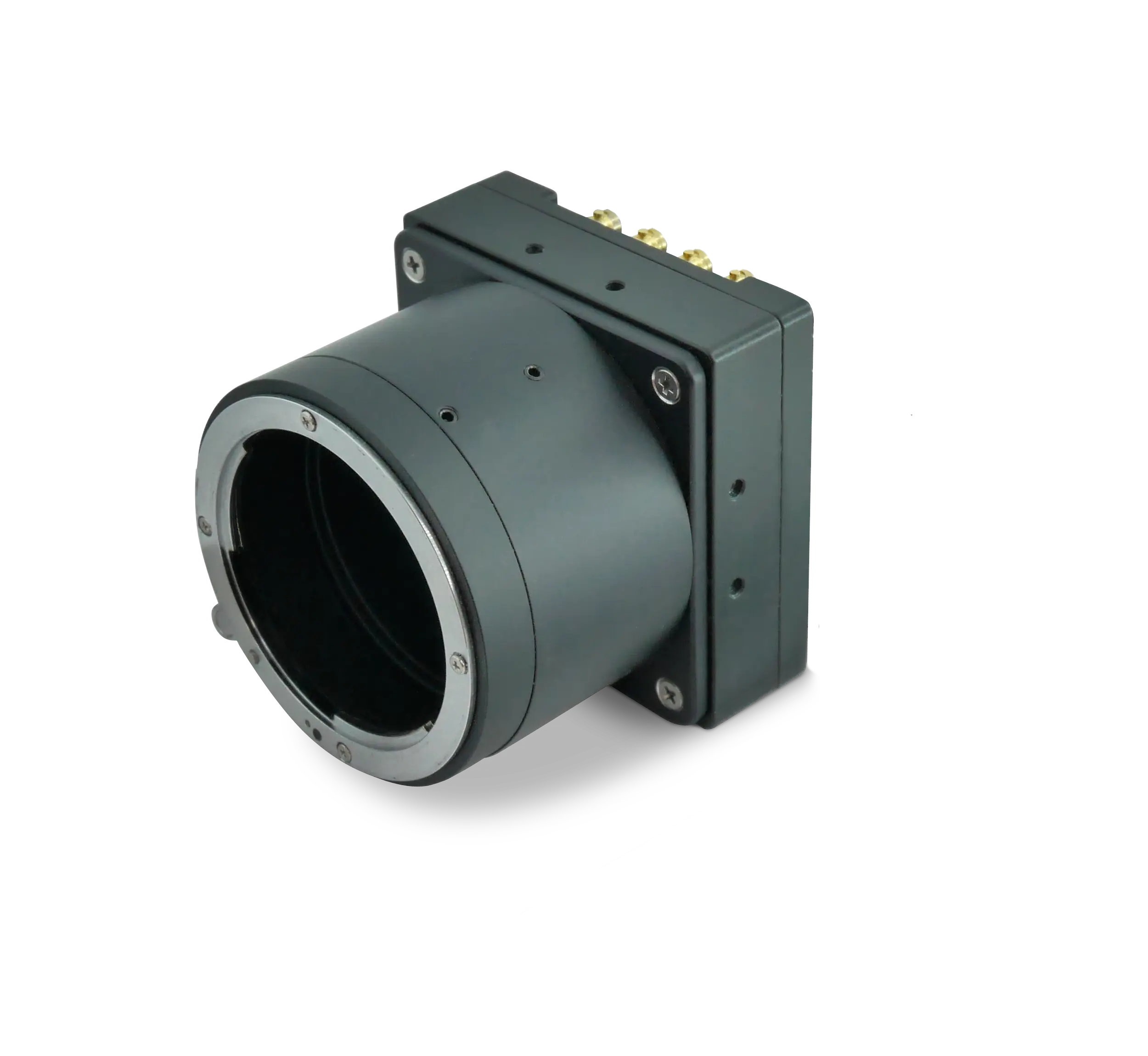
Both the Iron 2011E and Iron 3249 employ advanced Gpixel global-shutter CMOS sensors. The Iron 2011E uses the GSENSE2011E, enabling very high sensitivity in poorly lit sled or barrier tests. Its compact housing, tested for harsh environments, keeps shock and vibration from corrupting data during peak impact. Meanwhile, the Iron 3249 scales resolution up to 38 megapixels with the GMAX3249 sensor, empowering engineers to zoom into air-bag folds, pretensioner components, or micro-fractures in composite pillars without swapping optics.
KAYA Vision prioritizes bit-perfect capture. Both cameras use CoaXPress v2.1 to stream uncompressed 8-, 10-, or 12-bit data at up to 12.5 Gbps per cable. Latency remains microsecond-level, a critical factor when integrating camera timing with high-G accelerometers, dummies, and pyrotechnic squibs.
Moving data without bottlenecks
Even the most sophisticated sensor is limited by the path between camera and storage. Laboratories accustomed to GigE Vision high-speed recording often discover that 1 GbE or even 10 GbE saturates quickly at frame rates above 1 kfps. CoaXPress provides headroom, and KAYA Vision delivers the link layer in the Predator II Single CoaXPress 12G Frame Grabber. By supporting one 12.5 Gbps channel, Predator II enables single-cable setups for Iron 2011E while leaving PCIe bandwidth free for GPUs that execute real-time analytics such as optical flow, strain mapping, and occupant motion tracking.
When the test plan calls for more sensors—roof, footwell, steering column—a multi-link strategy becomes essential. The Komodo Quad Camera Link High Speed Compatible Frame Grabber answers with four CLHS X-Protocol lanes each running at 10 Gbps. Engineers can mix Iron 3249 units for ultra-high resolution with third-party cameras feeding GigE Vision high-speed recording streams, unifying all data in one PCIe slot. By using direct memory access (DMA), Komodo achieves sustained disk rates that match or exceed NVMe arrays, preventing frame drops during catastrophic impact sequences.
Computational imaging for crash test cameras
The days of post-event manual measurement are over. Today’s analytic pipeline begins the moment exposure ends. KAYA Vision’s SDK exposes sensor metadata—exposure time, gain, temperature—that becomes input for deblurring, HDR fusion, and lens-distortion correction. Engineers can load GPU or FPGA plug-ins that isolate seat-belt stretch or quantify A-pillar displacement in real time. Such automation not only speeds regulatory reporting but allows iterative design loops within a single workday.
A typical frontal crash scenario illustrates the workflow. Iron 2011E units mounted at 5000 fps record occupant kinematics, while an Iron 3249 on the exterior captures panel deformation at 2000 fps. Predator II boards feed imagery directly into a CUDA-based neural network that tracks dummy chest deflection. Simultaneously, Komodo aggregates data from side-mounted cameras delivering GigE Vision high-speed recording to satisfy legacy departmental standards. Within minutes of impact, engineers review overlaid skeletal models, annotated deformation maps, and synchronized accelerometer traces—all synchronized to sub-microsecond clock packets embedded by KAYA hardware.
Synchronizing optics, lighting, and triggers
Illumination often proves the forgotten variable in high-speed crash test cameras. Higher frame rates demand shorter exposure times, which in turn require intense, flicker-free lighting. The Iron series supports programmable strobe outputs via CoaXPress I/O, letting engineers trigger high-power LEDs exactly at mid-exposure to maximize photon economy while minimizing heat inside the cabin. Because KAYA frame grabbers propagate the same trigger signal with nanosecond precision, multi-camera arrays remain phase-locked even under the violent acceleration of an offset crash.
For scenarios that combine visible and near-infrared imaging—such as monitoring battery-pack thermal runaway—the global shutter inside Iron sensors eliminates rolling artifacts when alternating spectrally tuned strobes. That capability pairs well with computational imaging for automotive safety workflows that use spectral band selection to separate occupant skin from seat fabric or identify hot spots on power electronics.
Data integrity and harsh-environment resilience
Crash labs expose cameras to unpredictable forces: panel intrusion, pyrotechnic residue, electromagnetic pulses from air-bag igniters. Iron housings are CNC-machined, with hermetic lens mounts and industrial-grade connectors rated to MIL-STD shock profiles. Inside, on-sensor temperature diodes feed into KAYA’s adaptive exposure algorithm, preventing hot pixels that could skew optical strain calculations. Frame grabbers add another layer of protection; both Predator II and Komodo offer CRC checks per packet, ensuring that the terabytes streamed during a single test remain free of silent corruption.
From pixels to policy
Automakers are under pressure to validate advanced driver-assistance systems (ADAS) and autonomous functions that intervene milliseconds before impact. When tests involve active braking or steering, the timeline expands beyond immediate collision to the seconds leading up to it. GigE Vision high-speed recording is often used on proving grounds to capture long-duration pre-crash sequences at modest frame rates. KAYA Vision bridges that data with high-rate impact footage, enabling a cradle-to-grave dataset that spans sensor fusion events, electronic-stability control triggers, and final deformation.
This holistic record empowers safety engineers to refine air-bag firing algorithms, legislators to assess compliance with evolving global NCAP protocols, and insurers to calibrate next-generation black-box devices. In each case, reliable, synchronized imagery from high-speed crash test cameras forms the evidentiary backbone.
Streamlining crash test camera lab integration
KAYA Vision supplies more than hardware. The SDK supports C, C++, Python, and LabVIEW, easing integration into existing test-bench software. Direct GenICam compatibility means facilities can migrate from legacy GigE Vision high-speed recording devices without rewriting GUI panels or database hooks. Built-in compatibility with time-code generators, industrial PLCs, and mechanical high-G triggers eliminates custom soldering projects that once delayed test programs by weeks.
Engineers can allocate nursing boards to record pre-trigger buffers so that the milliseconds before barrier contact are preserved. When the trigger event fires, Predator II and Komodo automatically extend buffer length, ensuring continuous coverage during rebound phases—a period where roof crush and glass fragmentation studies often concentrate.
Cost efficiency without compromise
Budgets remain under scrutiny, especially as electric-vehicle platforms multiply validation permutations. KAYA Vision offers a competitive price point for crash test cameras, yet provides professional features such as lens hot-swapping and remote-head operation. Iron 3249 defers the usual trade-off between resolution and throughput; its CoaXPress interface paired with Predator II sustains imaging rates that alternative GigE Vision high-speed recording cameras cannot achieve even with link aggregation.
Because all components share a common API, test facilities can start with a single camera and frame grabber, then scale into multi-camera arrays over time without incurring software redevelopment costs. This modularity also simplifies spare-parts inventories; one Komodo board can backstop multiple rigs across sled, rollover, and drop-tower stations.
A new normal for crash analysis
As vehicles adopt composite structures, novel energy absorbers, and AI-driven restraint systems, the margin for measurement error narrows. KAYA Vision equips engineers with high-speed crash test cameras, computational imaging for automotive safety pipelines, and data-integrity-focused frame grabbers that keep pace with evolving regulatory landscapes. Whether integrating with legacy GigE Vision high-speed recording archives or building a green-field CoaXPress 12G lab, the Iron camera family, Predator II, and Komodo empower facilities to see more, measure more, and, ultimately, save more lives.